Structural Drying and Dehumidification in Granada Hills, CA
Surfaces dry in a day; framing, slabs and hardwood do not. The drying team maps moisture, sets equipment to the class of the loss and keeps it running until readings match a dry reference.
(888) 578-6508Get structural drying started in Granada Hills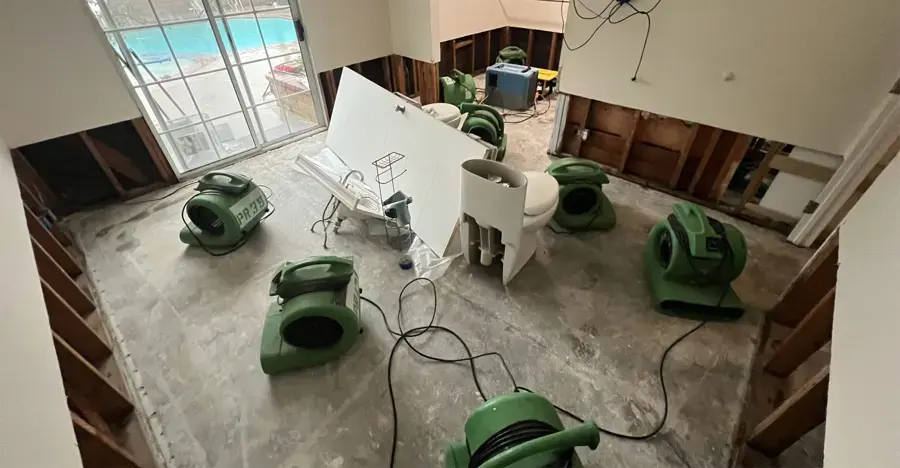
First steps for structural drying and dehumidification in Granada Hills
- Get the standing water out first
Extraction removes the water that drying would otherwise have to evaporate.
- Keep windows closed
Closed windows let the dehumidifiers work on a stable room instead of outdoor air.
- Leave the equipment running
Air movers and dehumidifiers work around the clock; switching them off at night slows drying.
- Keep drying rooms closed off
Closed doors and containment hold the dry air where it is needed.
How structural drying and dehumidification is handled in Granada Hills
Structural drying is the part of water damage restoration that takes the longest and matters the most. Carpet and drywall surfaces feel dry long before the framing, the slab and the hardwood underneath give up their water, and drying that stops at the surface leaves moisture behind the walls.
Rapid local response
The response team dispatches 24/7, and active water in Granada Hills is treated as urgent at any hour, weekends and holidays included.
IICRC S500 drying standard
The drying team maps moisture before equipment goes down and dries the structure, not just the surface, to the IICRC S500 goal.
Claim-ready documentation
The tech who does the walkthrough logs timestamped photos, a moisture map and daily psychrometric readings for the adjuster.
Local water know-how
Local restoration pros plan around hidden leaks under floors, root-blocked sewer laterals, attic AC drains and winter storm runoff.
What does structural drying and dehumidification cost in Granada Hills, CA?
Structural drying in Granada Hills typically runs $900 to $6,500, depending on the class of the loss, how many rooms are drying and how many days the equipment runs; slab and hardwood drying sits at the high end.
One room, Class 1 or 2
- Air movers and an LGR dehumidifier
- Moisture map and daily readings
- Three to five days typical
Several rooms, Class 3
- Wall cavity drying
- More dehumidifier capacity
- Containment where needed
Class 4: slab, hardwood, plaster
- Desiccant or low-grain drying
- Floor mats for hardwood
- Extended daily logs
These are typical Granada Hills ranges, not a quote. Water category, wet square footage, material class and the hours before drying began move the final number. The Granada Hills water damage cost calculator narrows it for your loss.
The structural drying and dehumidification process, step by step
- 1
Moisture map
The tech who does the walkthrough maps wet materials with meters and thermal imaging and picks a dry reference.
- 2
Equipment placement
The drying team sets air movers and dehumidifiers to the class of the loss and tents areas as needed.
- 3
Daily readings
The drying crew logs moisture and psychrometric readings every day and adjusts the equipment.
- 4
Dry standard reached
Equipment comes out when materials read within 2 to 4 points of the dry reference.
How the drying team sets up a dry-out
Every dry-out starts with a moisture map: meters and thermal imaging show which materials are wet and how wet. The drying team then sets equipment to the class of the loss under the IICRC S500 standard.
- Class 1 and 2: air movers along the wet walls and floors, with LGR dehumidifiers sized to the room.
- Class 3: more air movers and dehumidifier capacity when water came from above and soaked walls high.
- Class 4: hardwood, plaster and concrete, which need low humidity, floor mats or desiccant dehumidifiers and more time.
Structural drying for slabs and hardwood in Granada Hills
Most Granada Hills homes sit on concrete slabs, and many have hardwood or engineered floors over them. Concrete and hardwood are dense, slow-drying materials, so the drying team tents the area to hold the dry air where it is needed and logs readings every day until the materials match a dry reference.
Valley weather helps and hurts. Hot, dry summer air speeds evaporation once water is out of the materials, while the rainy winter months keep indoor humidity higher, which is when dehumidifier capacity matters most.
Readings decide when structural drying is done
Equipment stays until the readings say dry, not until a set number of days passes. The drying goal is a reading within 2 to 4 points of a dry reference material in the same home, and the daily psychrometric logs of temperature, humidity and grains per pound of moisture in the air go into the claim file.
- A moisture map on day one, with the wet area marked.
- Daily readings at the same points.
- Equipment adjusted as materials dry.
- Final readings that match the dry reference.
The EPA indoor air quality pages explain why indoor moisture matters, and the Ready.gov flood page covers safety after water gets inside. The drying time estimator shows a typical window for a loss.
Structural Drying and Dehumidification across Granada Hills and the north Valley
24/7 dispatch and rapid local response for Granada Hills, CA, day or night.
Granada Hills Water Damage Restoration covers ZIP 91344 and 91394: Old Granada Hills along Chatsworth Street, Granada Hills North up to the O'Melveny Park foothills, Balboa Highlands, Knollwood and Granada Hills South along the Bull Creek channel.
Nearby coverage reaches Northridge, Porter Ranch, Mission Hills, North Hills, Sylmar, Chatsworth.
See every Granada Hills area and ZIP coveredStructural Drying and Dehumidification questions in Granada Hills, CA
Water still moving in Granada Hills?
Still wet behind the walls? The drying team works to readings, not guesses.
(888) 578-6508 Granada Hills structural drying helpWhat is structural drying?
Drying the building itself, not just the surfaces: framing, wall cavities, subfloor, slab and hardwood. It uses air movers, dehumidifiers and daily readings to reach a measured dry standard.
How long does structural drying take?
A contained Class 1 loss usually dries in three to five days. Class 3 and Class 4 losses, with soaked walls, slabs or hardwood, take longer, and equipment stays until readings say dry.
What is an LGR dehumidifier?
A low grain refrigerant dehumidifier pulls more moisture out of the air than a household unit, which keeps wet materials releasing water. Desiccant dehumidifiers go lower still for slabs and hardwood.
Why can't the fans come out when the carpet feels dry?
Surfaces dry first. Framing, the slab and the wall bottoms still hold water, and that moisture comes back into the room if drying stops early. Readings decide.
What does 2 to 4 points of dry mean?
The drying team takes a reading on the same material in an unaffected part of the home. Wet materials count as dry when they read within 2 to 4 points of that reference.
Does insurance pay for drying equipment?
Drying after a covered loss is usually part of the claim, and the daily logs show why the equipment ran as long as it did. Coverage depends on your policy, so check with your own insurer.
Water damage in Granada Hills? Dry it to the standard.
Moisture left in framing and slabs shows up again after the repair. The drying team keeps equipment running until the readings say dry.
(888) 578-6508Granada Hills drying team, 24/7