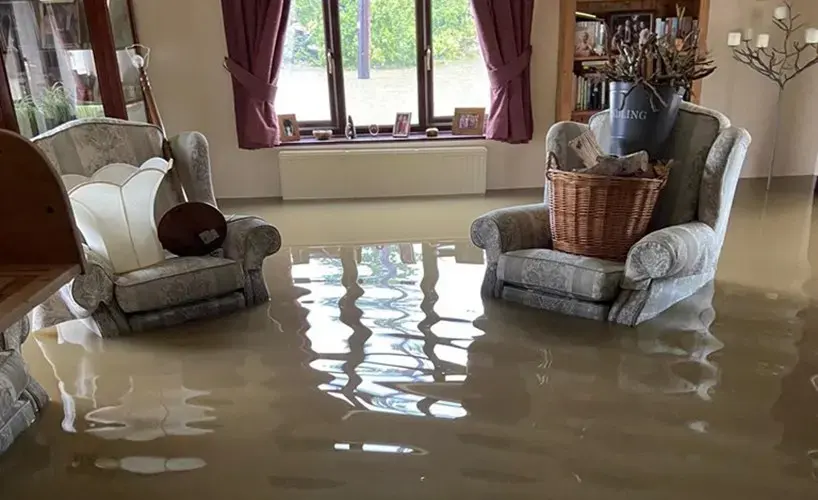
A wildfire strips the plants that slow rain down, and the next big storm can send mud, rock and runoff toward the homes below. Santa Clarita's hazard plan says burn scars from three fires raised the risk of flash floods and debris flows in parts of Canyon Country, Sand Canyon and Placerita Canyon.
Key takeaways
- The city's hazard plan says burn scars from the 2016 Sand Fire, the 2017 Rye Fire and the 2019 Tick Fire raised flash flood and debris flow risk in areas such as Canyon Country, Sand Canyon and Placerita Canyon.
- Rain falls mainly from December through March, so the weeks before it are the time to clear drains and check where water will go.
- Flood water that carries mud and debris is treated as contaminated, so wet carpet, pad and drywall are removed rather than dried in place.
- The detention basins in Canyon Country and Valencia can reach capacity in extreme atmospheric river storms, so runoff can still reach streets and yards.
- Photos of the water level on walls and furniture, taken before cleanup, support the claim, and coverage depends on the policy.
Why burned slopes send more water downhill
Plants and roots hold soil and slow rain. After a fire, bare slopes shed water faster and carry ash, mud and rock with it.
The city's hazard plan, which is still a public draft, says burn scars from the 2016 Sand Fire, the 2017 Rye Fire and the 2019 Tick Fire raised flash flood and debris flow risk in areas such as Canyon Country, Sand Canyon and Placerita Canyon.
The same plan says localized stormwater flooding remains a hazard even in the parts of the city mapped as minimal flood hazard. When water does get past the slopes and basins, storm runoff and flood cleanup is the work that follows.
- Faster runoff after short, heavy bursts of rain.
- Ash, mud and small rocks mixed into the water.
- Debris that clogs drains and gutters and turns a manageable flow into a spill.
Canyons, creeks and the Santa Clara River
The Santa Clara River crosses the city from east to west. It is usually dry, but it shows significant surface flow during seasonal heavy rain.
Where the runoff comes from
The river's tributaries cut steep canyons, and the largest are Bouquet Canyon, San Francisquito Canyon, Sand Canyon and Soledad Canyon.
The hazard plan names San Francisquito Creek, Bouquet Canyon Creek, Placerita Creek and Mint Canyon Wash as drainages that carry runoff from the Angeles National Forest and nearby mountain slopes into the river.
What catches it
Los Angeles County Flood Control District facilities include the Placerita Canyon Debris Basin, the San Francisquito debris basins and detention basins in Canyon Country and Valencia. The plan adds that the detention basins can reach capacity in extreme atmospheric river storms.
Homes near the canyons
Placerita Canyon and Sand Canyon are equestrian communities with large custom ranch homes. Sand Canyon, Aliento, Fair Oaks Ranch and Vista Canyon lie east of State Route 14 but inside the city limits.
A storm cleanup on a canyon property can reach beyond the house, because mud and water collect wherever the ground is low.
What recent storms showed
The hazard plan describes the January 2023 atmospheric river storms as causing ponding on major arterials, localized mudflows in Canyon Country and heavy runoff in the Santa Clara River channel.
It also says the remnants of Hurricane Hilary brought flooding along creeks, debris flows, downed trees and power outages to Santa Clarita in August 2023, and that the city assessed storm damage along the Soledad Canyon and Sand Canyon corridors afterward.
- Water moved fast and carried debris, not only rain.
- Trees and power were affected along with buildings.
- Damage followed canyon corridors and creeks as well as streets.
Getting ready before the rain
Rain falls mainly from December through March, which makes autumn the time for simple preparation. Atmospheric river storms can bring several days of heavy rain, so the list is worth finishing before the first one.
- Clear gutters, downspouts and yard drains so runoff has a path away from the house.
- Look at where water crosses the property in a heavy rain and keep that path open.
- Know where the main water shutoff and the electrical panel are.
- Move valuables and stored boxes off garage and ground floors.
- Photograph each room now, so there is a record of what was there.

When flood water reaches the house
Flood water and mud are not clean water. They can carry sewage, chemicals and debris, so the cleanup treats them as contaminated.
Standing water, electrical hazards and slippery mud all call for caution, and nobody should walk through water that could touch outlets or cords.
First steps
- Stay out of standing water if the power is on, and have the electricity shut off if the panel can be reached safely.
- Take photos of the water level on walls, furniture and floors.
- Keep children and pets out of the water and the mud.
- Move what can be moved to dry ground.
- Call for water extraction before mud dries into the floor.
What the cleanup removes
Mud and silt are shoveled and extracted. Carpet, pad and drywall that sat in the water are removed because porous materials cannot be made safe again.
Contents are sorted as the work goes. Plastic bins, metal tools and glazed tile can often be cleaned and treated, while mattresses, upholstered furniture and carpet cannot.
Drying the structure after the mud is out
Once the mud is gone, the work shifts to drying. Wall cavities, subfloors and framing hold water long after the surface looks dry, so air movers and dehumidifiers run until readings match a dry reference.
Mold can begin to grow in damp material after 24 to 48 hours, which is why drying starts quickly. Owners can start from water damage restoration in Santa Clarita when a storm reaches the house.
- Baseboards come off and wall cavities are opened where readings show water.
- Air movers and dehumidifiers run with daily readings logged.
- The job ends when framing and subfloor read like a dry reference.
Questions
Does a burn scar still raise flood risk years later?
The hazard plan counts burn scars from the 2016, 2017 and 2019 fires among the factors that raised flash flood and debris flow risk in parts of the city. Current conditions are best checked with the city and the Los Angeles County Flood Control District.
Are the creeks in Santa Clarita always flowing?
No. The Santa Clara River is usually dry and shows significant flow during seasonal heavy rain. The creeks that feed it carry runoff from nearby slopes and the Angeles National Forest.
What do debris basins do?
They catch debris and slow runoff coming out of the canyons. The hazard plan notes that the detention basins in Canyon Country and Valencia can reach capacity in extreme atmospheric river storms.
Is mud from a canyon storm contaminated?
Yes. Flood water and mud are treated as contaminated, which is why porous materials that soak in them are removed.
How soon should flood cleanup start?
As soon as it is safe to enter. Mud dries into floors and walls, standing water soaks into drywall and wood, and mold can begin to grow after 24 to 48 hours.
When does most rain fall in Santa Clarita?
Rain falls mainly from December through March, and temperatures rarely fall below freezing.